Showing posts with label football player. Show all posts

Thursday, June 30, 2011

Ronaldinho

Full name: Ronaldo de Assis Moreira
Date of birth: 21/03/1980

Early Career

Born Ronaldo de Assis Moreira in 1980, but more commonly known as Ronaldinho or Ronaldinho Gaucho (the name given to Brazilians who come from the Rio Grande do Sul area of Brazil), the Brazilian footballer is a renowned forward/ attacking mid-fielder and currently a key player in FC Barcelona. Dubbed the ‘new Pele,’ and regarded as one of the finest talents in the game today, Ronaldinho grew up in the Brazilian city of Porto Alegre and began his career at the youth team of Gremio, the team that first signed his older brother and current manager Roberto.
At the age of thirteen, Ronaldinho began to make his mark on the pitch, when he led his team to victory after scoring all twenty three goals in a local youth match. In 1997 he played in the Egypt Under-17 World Championship, where he impressively scored with two penalty kicks. He went on to represent the Gremio senior team at the Libertadores Cup, a championship for South American clubs, during which he caught media attention for his flair for goal-scoring and his remarkable ball control.

Professional Player

By 2001, having made a total of a hundred and ten appearances and thirty seven goals playing for Gremio and being the only player to have represented his country at all levels of competition (Under 15, 17, 20, 23 and senior teams), Ronaldinho had gained the football world’s attention and he began getting offers from international clubs including Arsenal and other top premiership teams. After much speculation about the next step in his career, Ronaldinho signed a five-year contract with Paris Saint-Germain (PSG) for four and a half million euros and left Brazil to begin a European football career.
Whilst Ronaldinho continued to display his talent for the game, scoring seventeen goals with PSG, he was heavily criticised on numerous occasions for his focus on the Parisian nightlife. In 2002 Ronaldinho represented Brazil as part of the winning team at the FIFA World Cup, scoring against China and a particularly notable goal against England in the quarter-finals. This was not his first successful performance with the Brazilian team, having already shone in the Under-17 World Cup, the Copa America and going on to be part of the champion team in the 2004-05 Confederations Cup.
After his impressive play in the 2002 World Cup, several clubs made multi million pound offers to PSG and a violent bidding war ensued between top international teams, Manchester United and FC Barcelona. After failing to reach an agreement with PSG, Manchester United lost the bid and in 2003 Ronaldinho moved to Spain for a hefty sum of twenty one million Euros.
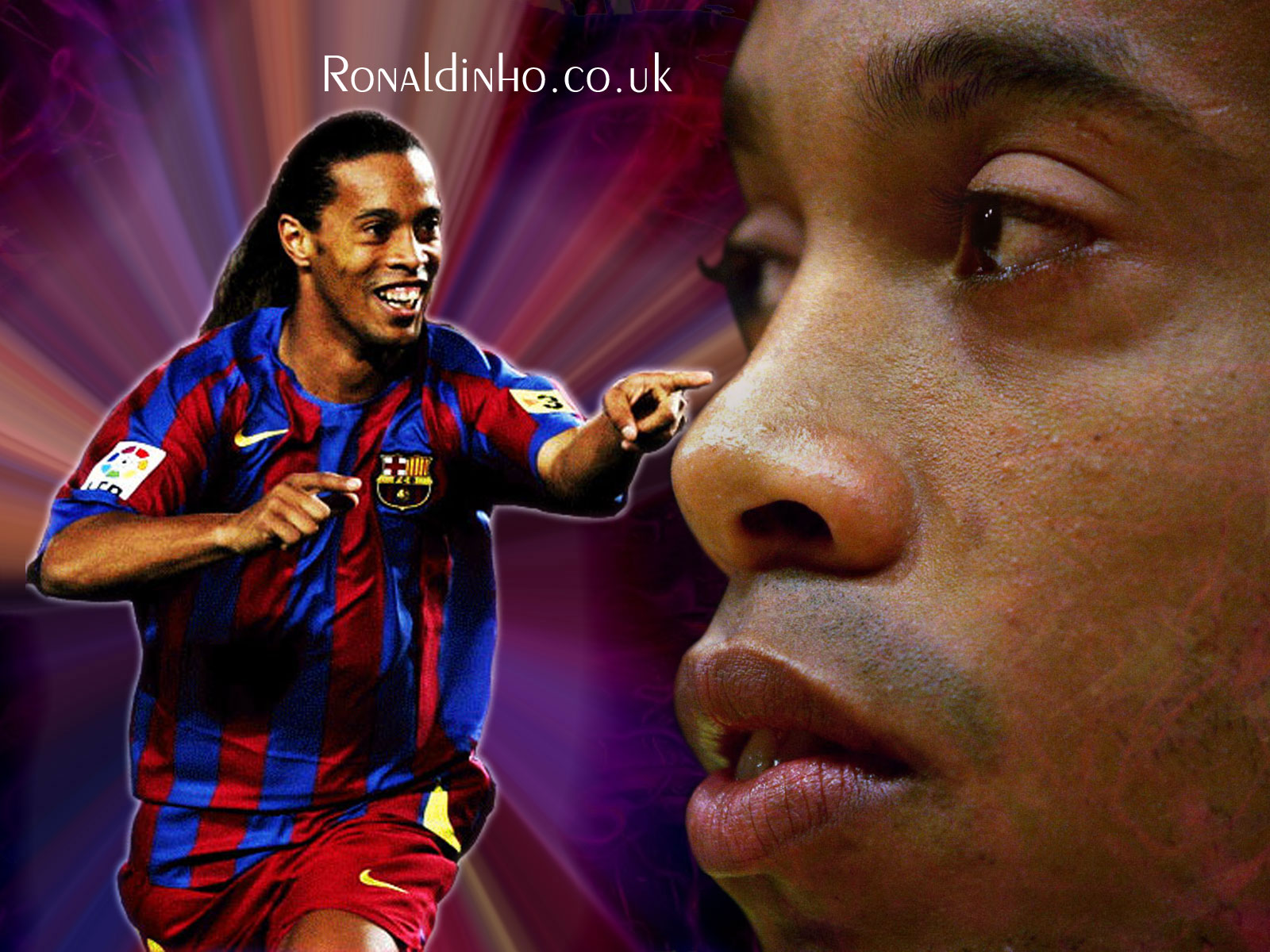
Since joining Barcelona, Ronaldinho has trained under the coaching of Frank Rijkaard, leading him to become more of a forward than a mid-field player with a focus on creating and scoring, rather than destroying and defending. Over the last four years Ronaldinho has made a significant contribution to FC Barcelona’s triumphs, contributing to the team's two year victory in the Spanish Supercup League. Barcelona were also victorious in the 2004/5 and 2005/6 La Liga titles and Ronaldinho made a significant contribution to their most recent triumph when Barcelona won the European Champion’s League in 2006.
Ronaldinho’s contract with FC Barcelona has fallen under much speculation, as several big international clubs have attempted to sign the player as their own. When vice-president Sandro Rosell resigned from the club in 2005, it was feared that Ronaldinho would refuse to extend his contract with Barcelona once it ends in 2008.
After a failed sixty million pound bid from Chelsea and his own refusal of an eighty five million pound bid with Barcelona that would take him up to 2014, Ronaldinho did extend his Barcelona contract for another two years. Ronaldinho will now stay with the club until 2010, unless another club offers at least eighty five million pounds to sign the Brazilian player.
Ronaldinho’s popularity continues to increase on and off the football pitch and, having starred in numerous advertisements for Nike, Pepsi, Lenovo and eight different Brazilian brands, he has surpassed David Beckham as the most marketable player in the world. Ronaldinho’s popularity was marked in 2005, when a twenty three foot high statue of him was erected in the Brazilian city of Chapeco, on winning his first FIFA player of the year award at the end of the 2004/05 season.
Alongside members of his family the striker also appears in a popular comic strip created by Brazilian cartoonist, Mauricio de Sousa. He is loved amongst football fans and professionals alike, having been awarded player of the world for two consecutive seasons and recently appearing in Pele’s much talked about 2004 list of 125 Top Footballers.

Key Moments

  • 2003/04: FC Barcelona v AC Milan - With a 1-0 lead in Ronaldinho’s first key match with Barcelona, the new striker increased their lead to 2-0 in the 51st minute, spinning the ball around Milan’s Fernando Redondo and into the net.
  • 2004: Away from the football pitch Ronaldinho has also filmed several advertisements. On one notable occasion whilst filming in Madrid, he kicked the ball so hard that it smashed a window in the historic Santiago de Compostela Cathedral.
  • 2005: FC Barcelona v Chelsea - At the Champions League final at Stamford Bridge, Ronaldinho scored an unstoppable solo goal and an impressive penalty kick. Despite the team being knocked out by Chelsea in a 4-0 defeat, the match has been remembered for the allegations that the stewards at the match had acted in a racist manner towards Ronaldinho.
  • 2005: Brazil v Argentina - Captaining his nation’s team to glory in the Confederation cup Ronaldinho received Man of the Match after a magnificent 4-1 defeat against Argentina.
  • 2006: FC Barcelona v PFC Levski Sofia - In Barcelona’s 5-0 defeat of PFC, Ronaldinho scored a stunning final goal in the final minute of the match.
  • 2006: FC Barcelona v Villareal - Ronaldinho scored a momentous goal when he scored an outstanding bicycle kick into the net.

Awards


Individual Honours

  • FIFPro World XI: 2005, 2006, 2007
  • FIFA Club World Cup Bronze Ball Award: 2006
  • Best Foreign Player in La Liga: 2004, 2006
  • UEFA Team of the Year: 2004, 2005, 2006
  • UEFA Club Footballer of the Year: 2006
  • FIFPro World Player of the Year: 2005, 2006
  • European Footballer of the Year: 2005
  • UEFA Club Best Forward: 2005
  • FIFA World Player of the Year: 2004, 2005
  • EFE Trophy: Best Ibero-American Player in La Liga: 2004
  • FIFA 100: 2004
  • FIFA World Cup 2002 All-Star Team: 2002
  • Rio Grande do Sul State Championship Top Scorer: 1999
  • FIFA Confederations Cup Golden Ball: 1999
  • FIFA Confederations Cup Top Scorer: 1999
Player Statistics

Senior Club and National Team Statistics
Period Team Appearances (Goals)
1998-2001 Grêmio 35 (14)
2001-2003 Paris Saint-Germain F.C. 55 (17)
2003-2008 F.C. Barcelona 145 (70)
2008-present A.C. Milan 3 (0)
1999-present Brazil 88 (35)

Ferenc Puskás

Full name: Ferenc Purczeld Biró
Date of birth: 02/04/1927
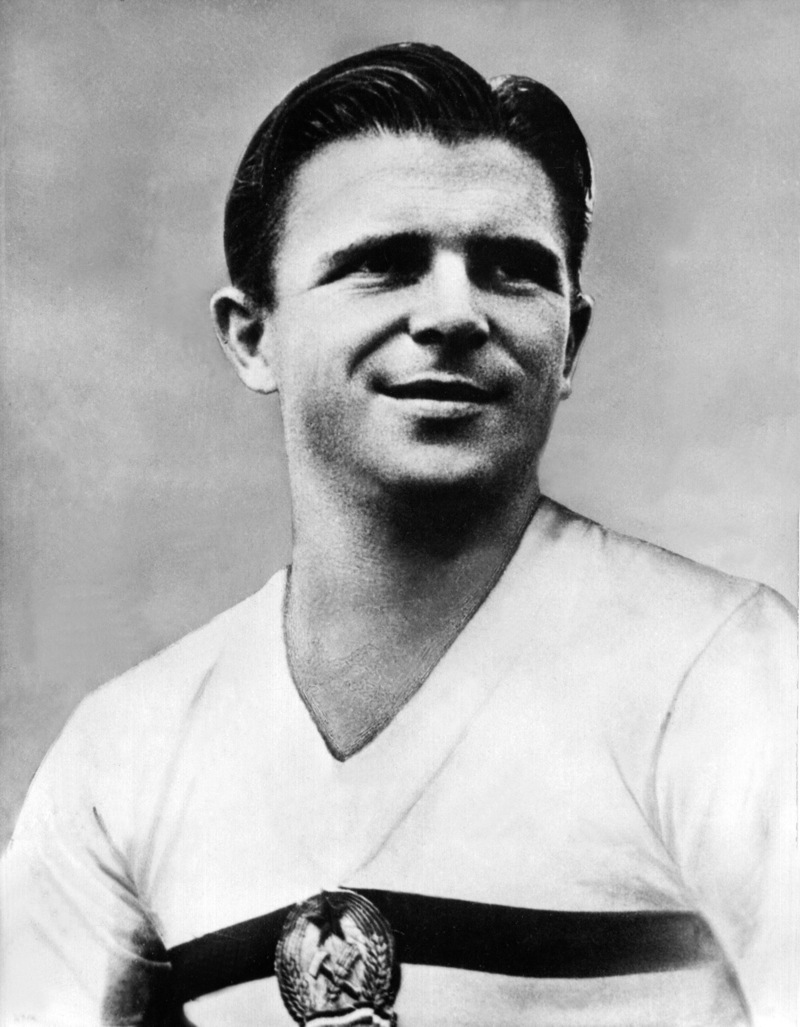
Ferenc Puskás is regarded as the greatest Hungarian footballer of all time and was part of the legendary international team known as the Mighty Magyars and the equally legendary Real Madrid team of the late 1950s and early 1960s, which included Alfredo Di Stefano.
Puskás was a prolific left footed striker, or inside forward, and scored 514 goals in 529 league games, and 84 goals in 85 internationals for Hungary. He also made four international appearances for Spain, without scoring. Nicknamed the Galloping Major, Puskás wasn't built like a footballer. Short, stocky, barrel chested and overweight, he was extremely one footed and couldn't head the ball!

The Galloping Major

Born in 1927, Puskás joined Kispest AC as a junior. He played under the assumed identity, Miklos Kovacs, until he was 12, and officially old enough to join, and made his first senior appearance for Kispest in November 1943, against Nagyvarad. In 1949, the club was taken over by the Hungarian Ministry of Defence, becoming the Hungarian Army team, and renamed Honved.
With Honved, Puskás won five Hungarian championships and finished as the league's top scorer four times. In the years in which he finished top scorer, he scored 50 (1947-48 season), 31 (1949-50), 25 (1950) and 27 (1953) goals. He was the top scorer in Europe in 1948. By the time he left in 1956, Puskás had scored a phenomenal 358 goals in 349 games

Mighty Magyars

Puskás made his debut for the Hungarian national team in 1945, at the age of 18, scoring in a 5-2 win over Austria. He formed an integral part of the team that went unbeaten for a world record 32 consecutive games, during which they became Olympic Champions in 1952, beating Yugoslavia 2-0 in the final in Helsinki. He played alongside other greats such as Zoltán Czibor, Sándor Kocsis, József Bozsik and Nándor Hidegkuti.
Puskás was part of the Mighty Magyars team that, in 1953, became the first non-UK team to beat England at Wembley, scoring two of Hungary's goals as they won 6-3. They also defeated England 7-1 in Budapest a year later.
In the 1954 World Cup, Hungary entered as hot favourites, and Puskás scored three goals in the two first round matches, but then suffered an ankle injury which ruled him out until the final. In the final, despite still showing the effects of his injury, he scored an early goal, and Hungary doubled their advantage to lead 2-0, but opponents West Germany clawed it back and took the lead with six minutes left 3-2. Puskás had a goal controversially disallowed for being offside, ending Hungary's record four year unbeaten run.

Stranded in Europe

When Honved entered the European Cup in 1956, little did they know they were to see the end of the team as they knew it. After losing 3-2 in the away leg at Atletico Bilbao, the players were left stranded in Europe due to the outbreak of the Hungarian Revolution in Budapest. The return leg, therefore, was arranged to be played at Heysel Stadium in Brussels and the game ended in a 3-3 draw, meaning Honved went out on aggregate 6-5. So, stuck on the continent, the team broke up and many players found clubs in Western Europe, including Puskás, who after a trial with Espanyol, eventually signed for Real Madrid.
Before arriving in Madrid in 1958, Puskás spent a year in Austria, but failed to get a playing permit. He wanted to play in Italy, and Juventus and AC Milan were interested before UEFA placed a two year ban on his shoulders. He piled on the pounds and being the wrong side of 30, clubs were unwilling to take a chance on him. Fortunately, his old Honved manager, Emil Oestreicher, rescued him from the wilderness and took him to the Bernabeu.

Real Madrid

Puskás spent eight seasons at Real Madrid, scoring 156 goals in 180 league games and was the league's top scorer four times. He helped Real win La Liga five times in a row between 1961 and 1965 and the Copa del Generalisimo in 1962, and formed a deadly partnership with the legendary Alfredo Di Stefano.
He played a further 39 games in the European Cup, scoring 35 goals. He helped Real reach the Final of the 1959 European Cup, but missed out through injury. He was back with a bang a year later though, scoring four times in a 7-3 triumph over German side Eintracht Frankfurt.
Two years later in the 1962 final, Puskás scored another hat trick, but Real were defeated 5-3 by Benfica. His third and last European Cup success came in 1966, with a 2-1 win over Partizan Belgrade. In all competitions, he scored 236 goals in 261 games for Madrid.
In 1962, Puskás took Spanish nationality and played four times for Spain at the 1962 World Cup. However, he failed to score as Spain crashed out at the first hurdle, winning just one of their qualifying matches, and finishing bottom of their group.

Coaching Career

After retiring as a player, Puskás went on to coach several teams across the world. His finest moment as a coach came in 1971, when he guided Panathinaikos to the European Cup Final, which remains the only time a Greek club has reached a European final. The side lost 2-0 to Ajax at Wembley. He also led the Greek side to two league championships, in 1971 and 1972. His only other success as a manager came with South Melbourne Hellas, whom he led to a National Soccer League title in 1991.
In 1993, he took charge of the Hungarian national team for four matches, having been forgiven for defecting to Spain to avoid the Soviet uprising in his homeland. In all, he coached teams in Spain, USA, Canada, Greece, Paraguay, Chile, Saudi Arabia and Egypt, including Deportivo Alaves, Vancouver Royals, Colo-Colo and AEK Athens.
Puskás was diagnosed with Alzheimer's disease in 2000 and died of pneumonia on November 17 2006 aged 79. The Nepstadion in Budapest was renamed the Stadion Puskás Ferenc in his honour in 2002.

Individual Honours

  • European Cup Top Scorer: 1964, 1960
  • Pichichi Trophy: 1964, 1963, 1961, 1960
  • Silver Ball European Footballer of the Year: 1960
  • Hungarian Top Goalscorer: 1953, 1950, 1948
  • World Player of the Year: 1953, 1952
  • Named in FIFA 100
  • European Player of the Century XX
  • Hungarian Player of the Century XX
  • Hungarian Top Goalscorer of the Century XX

Player Statistics

Senior Club and National Team Statistics
Period Team Appearances (Goals)
1943-1949 Kispest A.C.
177 (187)
1949-1955 Honvéd 164 (165)
1957 Espanyol (guest) n/a (n/a)
1958-1966 Real Madrid
182 (157)
1945-1956 Hungary 85 (84)
1961-1962 Spain 4 (0)
Related Posts Plugin for WordPress, Blogger...